Sun-Safe Crystals: Which Stones Can Go in Sunlight?
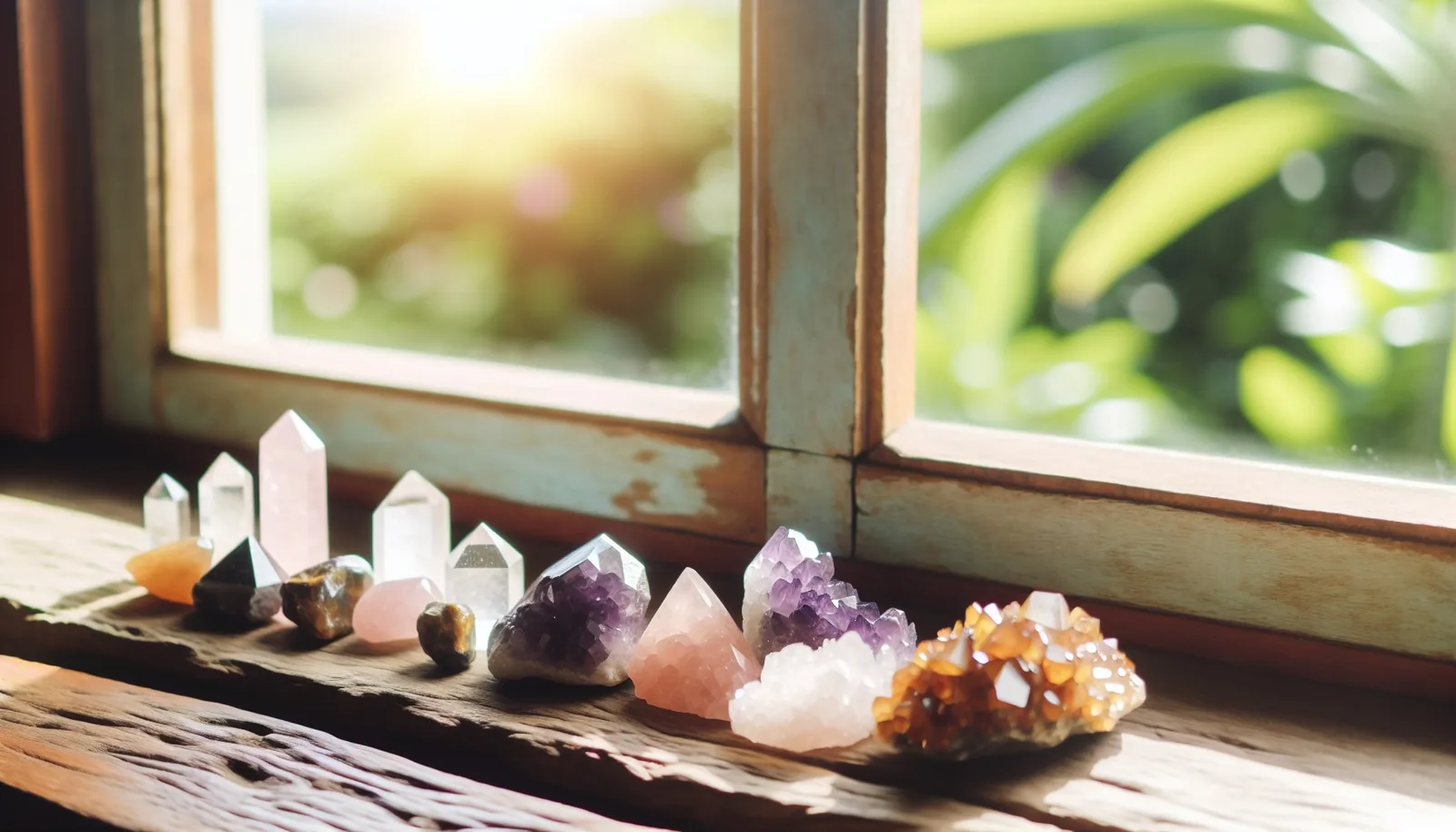
Stones colored by iron oxide, chromium, or structural effects are sun-safe and can charge outdoors without risk. Stones colored by radiation-induced color centers — including amethyst, smoky quartz, and many fluorites — will fade with prolonged UV exposure, because the same UV light that colored them destroys those color centers. Porous stones like opal risk crazing as surface water evaporates in heat. The 33-stone table below rates each stone with the physical reason.
Why Sunlight Damages Some Crystals: The Physical Mechanisms
Three distinct mechanisms cause sun damage, and knowing which applies to a stone tells you how urgent the restriction is.
Color center bleaching. Some crystals owe their color to structural defects — electron traps in the mineral lattice called color centers — created by natural gamma irradiation over geological time. Ultraviolet light carries enough energy to release electrons from these traps and restore the lattice to its uncolored state, permanently bleaching the stone. Amethyst is the primary example: its violet color comes from iron atoms (Fe3+) that form [FeO4]0 color centers when irradiated; UV exposure, including extended outdoor sunlight, reverses this. Mindat notes that prolonged sunlight exposure will slowly fade amethyst, and Brazilian material is particularly susceptible. Fluorite varieties colored by color centers — purple, blue, and some yellow material — behave the same way. Smoky quartz, whose grey-brown color also involves radiation-induced centers, can fade under intense light.
Thermal and desiccation cracking. Rapid temperature changes cause differential expansion along cleavage planes, which can open microfractures. Opal is uniquely vulnerable: it is a hydrated silica containing up to 20% water, and direct sun heat drives off that water irreversibly, causing surface cracking known as crazing. Selenite (gypsum, CaSO4·2H2O) can become chalky and brittle as bound water escapes. Moonstone and labradorite, as feldspar minerals with two perfect cleavage directions, can develop surface cracks with repeated thermal shock.
No damage, stable color. Stones colored by transition metals in stable coordination — chromium in ruby and emerald, iron oxide (hematite) in carnelian and red jasper, manganese in some garnets — are not affected by UV light. Dark stones like obsidian and black tourmaline absorb rather than transmit light and show no color change. These can be left in direct sun for solar charging without physical risk.
For general information on cleansing and charging methods, see how to cleanse crystals and how to charge crystals.
Stone-by-Stone Sun Safety Table
| Stone | Sun Rating | Mechanism |
|---|---|---|
| Carnelian | Safe | Iron oxide (hematite) color; UV-stable; exposure can deepen red-brown hue |
| Citrine | Safe | Most citrine is heat-treated amethyst; already thermally processed; stable |
| Diamond | Safe | Pure carbon; inert; colorless; no color centers at risk |
| Garnet | Safe | Iron, manganese, or chromium coordination color; UV-stable |
| Red jasper | Safe | Microcrystalline SiO2 colored by iron oxide; UV-stable |
| Ruby | Safe | Chromium color in corundum; highly UV-stable |
| Sapphire | Safe | Iron-titanium charge transfer color; UV-stable |
| Tiger's eye | Safe | Iron oxide in SiO2 pseudomorph; UV-stable |
| Black obsidian | Safe | Volcanic glass; dark color absorbs light; no color change |
| Black onyx | Safe | Dyed or naturally dark chalcedony; stable in direct sun |
| Black tourmaline | Safe | Iron in tourmaline lattice; dark color; UV-stable |
| Agate | Caution | Most natural agates are UV-stable; dyed agates may fade; limit to 1 hour |
| Aventurine | Caution | SiO2 with fuchsite inclusions; generally stable; limit to 30 min to be safe |
| Clear quartz | Caution | Colorless; no fading risk but acts as a convex lens — can focus sunlight and start fires; supervise or place on a non-flammable surface |
| Jade | Caution | Stable green from iron or chromium; limit to 30 min to avoid thermal stress on inclusions |
| Labradorite | Caution | Adularescence from structural layers is stable; avoid prolonged heat due to feldspar cleavage |
| Moonstone | Caution | Adularescence stable; two perfect cleavage planes risk microfracture from thermal shock; max 20 min |
| Rose quartz | Caution | Massive variety colored by fibrous inclusions is generally stable; euhedral/crystalline pink quartz fades quickly — treat as Never if crystal form |
| Sodalite | Caution | Most material stable; hackmanite variety is tenebrescent (lightens in sun, deepens in dark); limit to 15 min |
| Turquoise | Caution | Color from copper generally stable but surface oils and resins (common treatment) can bleach; limit exposure and keep dry |
| Amethyst | Never | Iron-based color centers (FeO4) destroyed by UV; fading is permanent and cumulative; keep out of direct sun |
| Aquamarine | Never | Blue from iron; can lighten under prolonged UV, particularly in heat-treated material |
| Fluorite | Never | Many color varieties rely on color centers that bleach readily in UV; avoid all direct sun |
| Howlite | Never | Naturally white and porous; dyed howlite (often blue or red) fades in UV; surface dries and chalks |
| Kyanite | Never | Blue from iron; can fade; perfect cleavage adds thermal stress risk |
| Larimar | Never | Blue from copper in pectolite; UV-sensitive; color reported to fade with prolonged sun exposure |
| Lapis lazuli | Never | Contains pyrite (oxidizes in heat) and calcite (thermal stress); sulfur-compound color can dull |
| Lepidolite | Never | Manganese-based color in mica; can fade in strong light; mica layers delaminate with heat cycling |
| Malachite | Never | Copper carbonate; sensitive to heat; prolonged sun exposure dulls surface and can damage polished finish |
| Opal | Never | Hydrated silica containing up to 20% water; direct sun heat drives off water, causing irreversible crazing and cracking |
| Pyrite | Never | FeS2; heat accelerates oxidation; prolonged sun warms the surface and promotes iron-sulfate formation |
| Selenite | Never | Gypsum (CaSO4·2H2O); bound water evaporates in heat, making the surface chalky and brittle |
| Smoky quartz | Never | Radiation-induced color centers; can fade under intense or prolonged light |
For individual stone cleansing methods, each stone's how-to-cleanse page covers safe alternatives — see how to cleanse amethyst, how to cleanse fluorite, or how to cleanse opal.
Charging Safely in Sunlight
For stones rated Safe, outdoor solar charging carries no physical risk. Practitioners traditionally place them in direct sunlight for 15 minutes to several hours, setting an intention for the session.
For stones rated Caution, keep the exposure brief — 15 to 30 minutes — and supervise. Bring stones indoors before temperatures peak in mid-afternoon.
For stones rated Never, use indirect light (reflected from a light-colored wall or through a sheer curtain) or charge under moonlight instead. Moonlight overnight avoids UV entirely and is the preferred method in crystal tradition for light-sensitive stones.
Fire safety note for clear quartz: Any clear, rounded or convex quartz piece can act as a lens that concentrates sunlight to a point hot enough to ignite paper or fabric. Place clear quartz specimens on stone, ceramic, or metal surfaces during outdoor charging, not on wooden surfaces or near anything flammable.
Protecting Sun-Sensitive Stones
Store amethyst, fluorite, rose quartz (crystalline variety), smoky quartz, and other color-center stones away from windows that receive direct afternoon sun. A north-facing shelf or a drawer is adequate. Display cases with UV-filtering glass or acrylic significantly slow fading for specimens that must be displayed near windows.
For salt cleansing safety with these same stones, see salt-safe crystals. For water safety, see what crystals can go in water. For definitions of crystals, minerals, and gemstones, see gemstone vs crystal vs mineral.