Larvikite vs Labradorite: Key Differences Explained
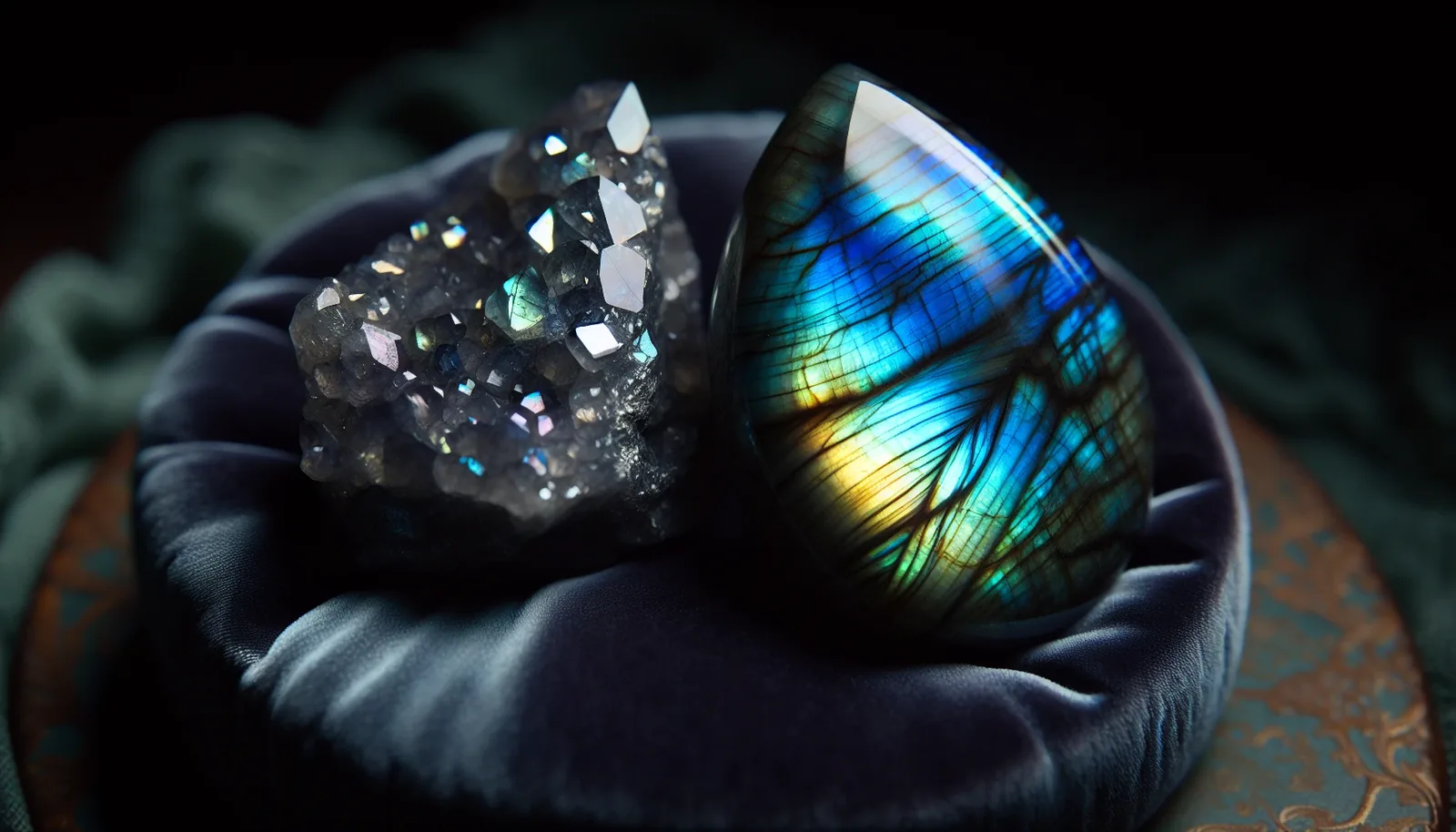
Larvikite and labradorite both display a silver-blue iridescence, but they are fundamentally different materials. Larvikite is a dark igneous rock (a variety of monzonite) composed of multiple minerals, quarried exclusively in Larvik, Norway. Labradorite is a feldspar mineral that occurs worldwide. Both show labradorescence, but through different structural mechanisms and at different scales.
What Larvikite Actually Is
Larvikite is not a mineral — it is a rock. Specifically, it is a variety of monzonite notable for thumbnail-sized crystals of ternary feldspar (a feldspar containing significant proportions of all three endmember feldspars: albite, orthoclase, and anorthite). The feldspar crystals have partially unmixed on the microscale to form a perthite texture, with alternating alkali feldspar and plagioclase layers producing its characteristic silver-blue schiller effect on polished surfaces.
The Larvik Batholith that hosts larvikite was emplaced during the Permian period, approximately 292–298 million years ago, in the Oslo Rift zone in Norway. Larvikite also occurs at the Killala Lake Alkalic Rock Complex near Thunder Bay, Ontario, but the Norwegian material is the commercial source. The International Union of Geological Sciences has designated larvikite a Global Heritage Stone Resource.
In the construction and decorative stone trade, larvikite is widely sold under the informal name "Blue Pearl Granite," though this is mineralogically inaccurate — it is neither granite nor blue.
What Labradorite Is
Labradorite is a calcium-rich plagioclase feldspar mineral, with the formula (Ca,Na)(Al,Si)₄O₈. It belongs to the feldspar group and occurs as a primary mineral in mafic igneous rocks including gabbro, basalt, and anorthosite, as well as in some metamorphic rocks.
Labradorite is found worldwide: major sources include Canada (Labrador, where it was first described), Madagascar, Australia, Mexico, Norway, and the United States. It is a discrete mineral that can be extracted and used as a gem, carved specimen, or architectural stone.
Side-by-Side Comparison
| Property | Larvikite | Labradorite |
|---|---|---|
| Category | Igneous rock (monzonite variety) | Feldspar mineral |
| Composition | Ternary feldspar + amphibole + titanaugite ± olivine | (Ca,Na)(Al,Si)₄O₈ |
| Mohs hardness | ~6–6.5 (feldspar-dominant) | 6–6.5 |
| Iridescence | Silver-blue schiller from perthite structure | Full-spectrum labradorescence from twinned layers |
| Color range | Dark gray to black with silver/blue flashes | Gray, dark gray; iridescent in blue, green, gold, orange |
| Origin | Larvik, Norway (exclusively) | Worldwide |
| Primary use | Architectural dimension stone, countertops | Gem cabochons, beads, carvings |
| Crystal faces | Rock — no individual crystal faces | Can show cleavage faces (two directions, ~86° and ~94°) |
For both materials, Mohs hardness places them in the same range as glass — they will scratch glass but can be scratched by quartz (Mohs 7). The Mohs hardness scale gives fuller context.
How to Tell Them Apart
Color of iridescence: Larvikite's schiller is almost exclusively silver-blue. Labradorite shows a broader color range — blue, green, gold, and occasionally orange or red — depending on the thickness of twinned layers. A stone showing vivid green or orange iridescence is labradorite, not larvikite.
Grain texture: Larvikite is a rock: look closely and you can see individual mineral grains of different types embedded in a dark matrix. Labradorite is a single mineral and shows more uniform internal structure.
Translucency: Polished labradorite cabochons are often slightly translucent at thin edges. Larvikite slabs are essentially opaque.
Shape of the piece: Larvikite is most commonly seen as large polished slabs, tiles, or countertops. Labradorite in the gem trade appears as cabochons, beads, carved spheres, and faceted stones.
The larvikite identification guide and labradorite identification guide cover hands-on tests in detail.
Practical Applications
Larvikite is primarily a building and interior design material — it clads the facades of commercial buildings globally and is used for kitchen and bathroom countertops. Its large-scale extraction makes it unsuitable for small gemstone cutting. In the crystal market, tumbled pieces and small cabochons are sold for metaphysical use.
Labradorite is a gem-trade staple cut primarily as cabochons to maximize the play of color. It is also popular as rough specimens, towers, and spheres. Unlike larvikite, labradorite can be found as transparent faceted stones (though these are less common and less valued than the best iridescent material).
Metaphysical Traditions
Larvikite is traditionally associated in crystal practices with grounding, patience, and protection — qualities attributed to its dense, earthy character. Labradorite is often called the Stone of Transformation and is used by practitioners for intuition, psychic development, and energetic protection. These are cultural and traditional associations, not evidence-based outcomes.