Black Tourmaline vs Obsidian: Key Differences
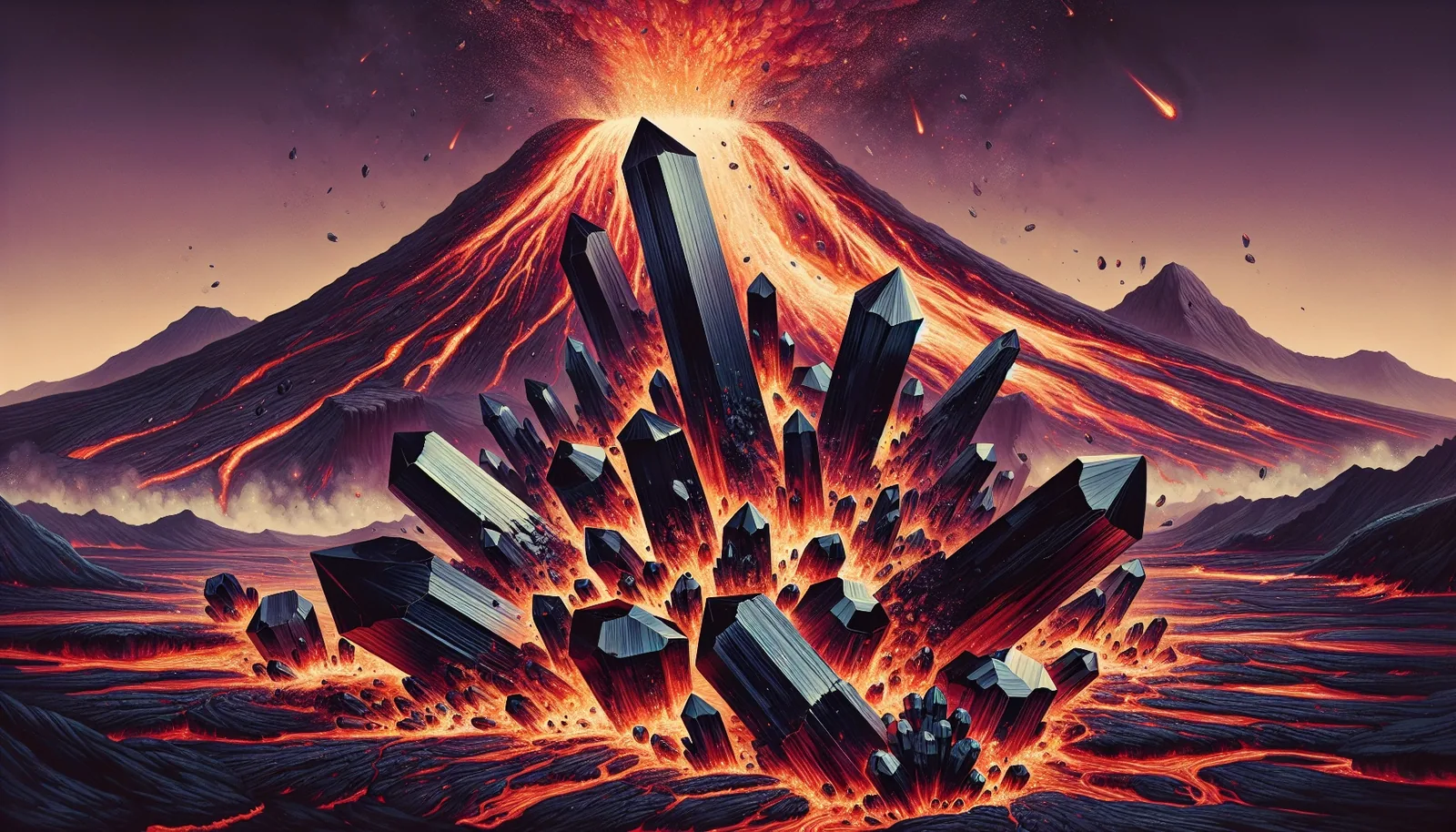
Black tourmaline (the variety known as schorl) is a crystalline boron silicate mineral with a Mohs hardness of 7 to 7.5. Obsidian is volcanic glass — not a mineral at all — with a Mohs hardness of 5 to 5.5. Both are black and opaque, but they differ in hardness, crystal structure, texture, origin, and how they break. A steel knife test tells them apart in seconds.
What Each Material Is
Black tourmaline (schorl) is a mineral in the tourmaline group with the approximate formula NaFe₃Al₆(BO₃)₃Si₆O₁₈(OH)₄. It belongs to the silicate class and crystallizes in the trigonal system. Its black color is attributed to high iron content. Schorl is the most abundant tourmaline species and is found in granites, pegmatites, and metamorphic rocks worldwide. Major localities include Brazil, Africa (Namibia, Tanzania), southern Africa, and the United States (Maine, California).
Obsidian is not a mineral — it is a naturally occurring volcanic glass. It forms when silica-rich (felsic) lava cools rapidly, preventing the atoms from organizing into a crystalline structure. The result is an amorphous solid with no definable crystal structure. Obsidian is essentially a glass with high silica content, rich in feldspar components, and is found in volcanic regions globally: Mexico, Argentina, Iceland, Italy, and the western United States.
Side-by-Side Comparison
| Property | Black Tourmaline (Schorl) | Obsidian |
|---|---|---|
| Category | Crystalline mineral | Volcanic glass (amorphous) |
| Chemical composition | NaFe₃Al₆(BO₃)₃Si₆O₁₈(OH)₄ (approx.) | Primarily SiO₂ with Al₂O₃, Fe oxides |
| Mohs hardness | 7–7.5 | 5–5.5 |
| Crystal system | Trigonal | None (amorphous) |
| Luster | Vitreous to resinous | Vitreous |
| Fracture | Uneven to conchoidal | Conchoidal — extremely sharp edges |
| Crystal habit | Elongated prismatic columns, often striated lengthwise | No crystal form; smooth glassy surfaces |
| Streak | White | White |
| Transparency | Opaque | Opaque to slightly translucent at thin edges |
| Specific gravity | 3.02–3.26 | ~2.35 |
| Formation | Hydrothermal / pegmatitic crystallization | Rapid cooling of volcanic lava |
Hardness: The Fastest Practical Test
Black tourmaline at Mohs 7–7.5 will easily scratch glass and a steel pocket knife (~5.5). Obsidian at Mohs 5–5.5 will be scratched by a steel knife. This single test distinguishes them quickly on rough or tumbled specimens:
- Use the edge of a steel knife against an inconspicuous spot.
- If the stone scratches the knife (or resists being scratched) — likely tourmaline.
- If the knife scratches the stone easily — likely obsidian.
For a full hardness reference, see the Mohs hardness scale.
Appearance: How to Tell Them Apart Visually
Crystal form: Natural black tourmaline forms elongated three-sided prismatic columns. The long faces of these prisms are often striated — marked with fine grooves running parallel to the crystal's length. These striations are a diagnostic feature of tourmaline and do not appear on obsidian.
Surface texture: Obsidian has a smooth, glossy, glass-like surface that reflects light evenly. Raw obsidian breaks with conchoidal fracture — the same curved, shell-like break surface as glass — and produces edges sharp enough to cut skin. Raw tourmaline has rougher, uneven fracture surfaces.
Translucency: Thin edges of obsidian can appear slightly translucent or even transparent under bright light. Black tourmaline is fully opaque at any thickness.
Varieties: Obsidian occurs in several varieties: black (most common), mahogany obsidian (brown/black streaks), snowflake obsidian (gray-white felsite inclusions), and rainbow obsidian (iridescent surface sheen from nanolayers). All have the same hardness and glass character. Black tourmaline is uniformly black; its most common variety distinction is between natural rough (prismatic crystals) and polished/tumbled material.
See the black tourmaline identification guide and the obsidian identification guide for additional tests.
Durability and Care
Black tourmaline's greater hardness makes it more suitable for everyday jewelry. At Mohs 7–7.5, it resists scratching from most surfaces encountered in daily wear. Clean with warm water and mild soap; avoid ultrasonic cleaners with included specimens.
Obsidian at Mohs 5–5.5 is softer and more susceptible to scratching. Its glassy fracture also makes it susceptible to chipping from sharp impacts — the same quality that made it so effective as a cutting tool in prehistoric cultures. Obsidian is best used in low-impact jewelry settings (pendants, earrings) or as tumbled stones, spheres, and carvings rather than rings.
Both materials are stable in water for brief rinsing. Neither is water-soluble at normal pH.
Safety Note
Raw obsidian produces extremely sharp edges when fractured — comparable to surgical glass. Handle raw specimens carefully and store them where children cannot access them.
Metaphysical Traditions
Black tourmaline is traditionally used in crystal practices for protection and grounding. Practitioners place it near entrances, carry it as a protective talisman, and associate it with the root chakra. Obsidian is used as a grounding and protective stone in similar contexts, and is additionally associated with truth, self-reflection, and uncovering hidden patterns. These are cultural traditions, not evidence-based claims, and crystals are not a substitute for professional care.
Which to Choose
For jewelry durability, black tourmaline is the stronger choice. For distinctive visual impact — the glossy, mirror-like surface and color variants — obsidian has appeal that tourmaline's matte surface does not replicate. For crystal collections, both are widely available at modest price points.